
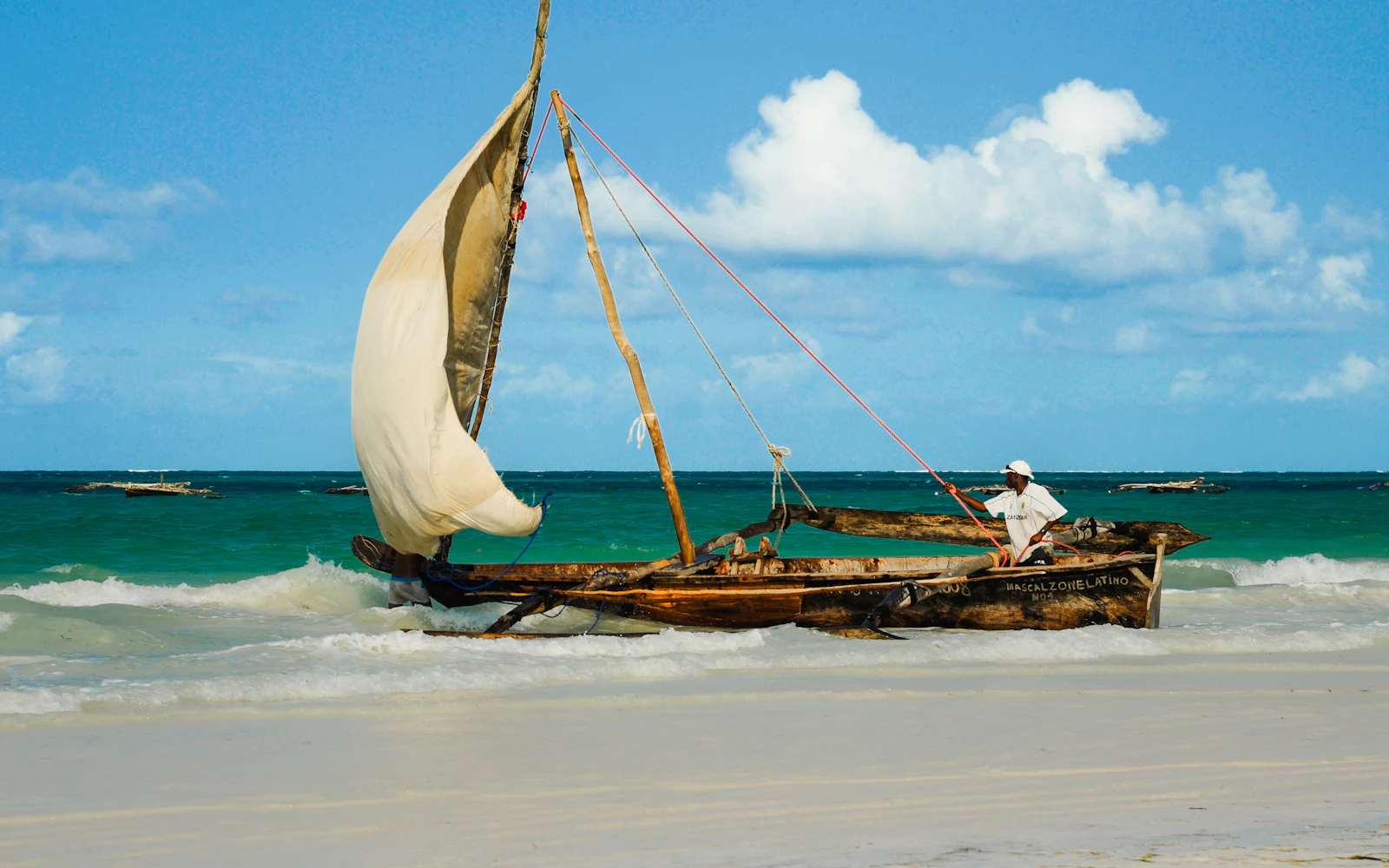
Kiwengwa Beach, Zanzibar: Tides, Forest Caves and Things to Do
Updated November 17, 2026 · Zanzibar Ibrahim Tours
Photo: Lu / Unsplash
Kiwengwa beach is a long, palm-lined stretch of white sand on Zanzibar's north-east coast, known for its large resorts, a wide tidal lagoon and the coral caves of the Kiwengwa–Pongwe Forest Reserve just inland. Swim around high tide, walk the flats at low tide, and expect a resort-based stay rather than a lively village scene.
Kiwengwa at a glance
- Where: the north-east coast of Unguja, between Pwani Mchangani to the north and Pongwe to the south.
- The beach: long, flat and sandy, with a lagoon and reef offshore.
- Tides: big. The sea goes a long way out at low tide and fills the lagoon at high tide.
- Feel: mostly large resorts, many of them all-inclusive, with a small village behind.
- Drive time: roughly 45 minutes to an hour from the airport or Stone Town.
- Nearby: the forest caves, quieter Pongwe and Uroa, and Mnemba boat trips from Matemwe.
Kiwengwa beach at high and low tide
Zanzibar has two high and two low tides a day, and the spring tidal range is more than three metres. On a flat coast like Kiwengwa's, that turns the beach into two different places.
High tide
The lagoon fills with clear, shallow water in front of the hotels. This is the time to swim, kayak or paddle, and the water is usually calm inside the reef.
Low tide
The sea draws back towards the reef and leaves sand, seagrass and rock pools. Local women tend seaweed in the shallows and fishermen walk out to their boats. It is a good time for a long walk, in reef shoes, but not for swimming.
Spring tides around full and new moon give the biggest difference; neap tides in between give much less. Almost every resort here has a pool for the hours when the sea is out. Our Zanzibar tides guide explains how to read a tide table for your dates.
The Kiwengwa–Pongwe Forest Reserve and the Kiwengwa caves
Just inland from the beach, the Kiwengwa–Pongwe Forest Reserve protects a patch of coral rag forest, the scrubby woodland that grows on old coral limestone. It is home to Zanzibar red colobus monkeys, Sykes' monkeys and the small Aders' duiker antelope, with around 47 recorded bird species and about 100 plant species, many used in traditional medicine.
The forest has been under pressure from timber cutting since the 1970s, and an ecotourism project began in the mid-2000s to give local communities an income from protecting it.
Visiting the caves
The reserve contains several coral limestone caves with stalactites, stalagmites and openings in the roof that let in daylight. They were found by a forest guard in 2002. Two of the main caves have been open to visitors, while another is left for the wildlife, including several species of bats.
- Go with a local guide; entry arrangements and fees change, so confirm locally before you go.
- Wear closed shoes. Floors can be uneven, and some passages are low.
- Bring a torch and some insect repellent for the forest walk.
- Keep your voice down and do not touch the formations or disturb the bats.
Red colobus can be seen in this forest, but sightings are far more reliable at Jozani Forest in the south of the island.
Pongwe and Uroa: Kiwengwa's quieter neighbours
Pongwe, just south of Kiwengwa, has small sandy coves and a handful of smaller hotels. One specialist operator describes it as one of the few east-coast beaches that is not tidal. In practice the water stays closer to the sand than on most of this coast, though it still changes with the tide.
Uroa, a few kilometres further south, is a fishing village with a few small hotels and the same tidal pattern as Kiwengwa. It suits travellers who want something simpler and more local than the resort strip.
Pwani Mchangani, just north, is a village between Kiwengwa and Matemwe and the starting point of our quad bike tour through local villages, forest and off-road trails.
Who Kiwengwa suits (and who it doesn't)
A good fit if you
- Want an all-inclusive or full-board resort holiday with pools, entertainment and everything on site.
- Are travelling with children and want resort facilities and shallow water at high tide.
- Want to be reasonably close to the airport and to Mnemba boat departures.
- Prefer a sunrise walk to a sunset party.
Think twice if you
- Want to swim at any time of day. Nungwi and Kendwa on the north-west coast are far less tidal.
- Want a choice of independent restaurants and bars within walking distance.
- Want to kitesurf. Kite schools say the north-east resort beaches are not really kite spots; Paje is.
- Want a village atmosphere. Kiwengwa is resort-led; Matemwe or Jambiani feel more local.
If you are weighing up an all-inclusive package here, our Zanzibar all-inclusive guide covers what is usually included and what to check.
Things to do in Kiwengwa
- Walk the beach at low tide: head north towards Pwani Mchangani or south towards Pongwe early in the morning.
- Watch the sunrise: Kiwengwa faces east, so the sun comes up over the reef.
- Explore the forest and caves: a half-day with a guide, best in the cooler morning.
- Kayak and paddleboard: most resorts have them for use at high tide.
- Quad biking: a three-hour ride from neighbouring Pwani Mchangani.
- Snorkel Mnemba: boats leave from Matemwe, a short drive north.
Day trips from Kiwengwa
- Mnemba Atoll: our Mnemba Island tour departs from Matemwe beach, around 20 to 30 minutes' drive north of most Kiwengwa hotels. Read our Matemwe beach guide for how the boat trip works.
- A spice farm: the spice farms in the centre of the island are under an hour away. Our Zanzibar spice tour shows how cloves, nutmeg, vanilla and cinnamon are grown.
- Stone Town: around 45 minutes to an hour away, worth a full day with a guide and dinner in town.
- Nungwi and Kendwa: roughly an hour north for the turtle lagoon, beach bars and a sunset swim.
- Jozani Forest: about an hour south for the best chance of seeing red colobus monkeys.
How to get to Kiwengwa
- From the airport: about 45 km, roughly 45 minutes to an hour by road. A pre-booked airport transfer is the simplest way to arrive at a resort.
- From Stone Town: around 50 minutes to an hour.
- By dala dala: public minibuses run from Stone Town towards the north-east coast. They are cheap but slow and awkward with luggage.
- From Paje: allow at least an hour and a quarter; the road goes inland.
Where to eat and stay in Kiwengwa
The main Kiwengwa strip is lined with large resorts, many all-inclusive and several run by European operators, including Italian ones. Pongwe has smaller hotels in quieter coves, and Uroa has simpler places to stay closer to village life.
Most people eat where they stay. There are a few beach restaurants and local eateries in the village, but they are spread out and quiet in the evening. If you are all-inclusive, consider booking a dinner out in Stone Town or a lunch in a nearby village to taste local Zanzibari food. For booking questions, see where to stay in Zanzibar.
Best time to visit Kiwengwa
Kiwengwa is warm all year. The most popular months are roughly June to October and late December to February, when rain is less frequent. From June to October the south-east trade wind blows along this coast, keeping afternoons fresh and sometimes breezy. The long rains, roughly mid-March to May, bring heavy downpours and fewer guests, and some resorts close or reduce services for part of that period. Resort prices usually peak around Christmas, New Year and the European summer holidays, so book early for those dates.
Local tips for Kiwengwa
- Check the tide each evening and plan sea swims around high water; use the pool at low tide.
- Pack reef shoes for the flats, the rocks and the caves.
- Beach sellers will offer excursions. Agree exactly what is included, including entry fees and pickup times, before you pay.
- Cover shoulders and knees when you leave the resort for the village.
- Carry small Tanzanian shilling notes for tips, village shops and cave guides.
- Use a taxi after dark rather than walking alone on empty sections of beach.
Plan it with Zanzibar Ibrahim Tours
We collect guests from Kiwengwa, Pongwe and Uroa hotels for Mnemba, quad biking, spice farms, Stone Town and airport transfers. Message us on WhatsApp (+255 675 366 829) or use our contact page with your hotel and dates, and we will plan around the tides. Current prices are on each tour page, such as the Mnemba Island tour.
Sources
- UK FCDO: Tanzania travel advice, safety and security
- Shaghude et al., Western Indian Ocean Journal of Marine Science (2002): tides around Zanzibar
- Wikipedia: Kiwengwa/Pongwe Forest Reserve (citing Government of Tanzania)
- Showcaves.com: Kiwengwa Caves
- Tanzania Odyssey: Zanzibar beaches (Pongwe)
- VOI Hotels: Kiwengwa resort location and distances
- Kite Centre Zanzibar: kitesurfing in Zanzibar
FAQs
Is Kiwengwa beach good for swimming?
Yes, around high tide, when the lagoon fills with calm, shallow water. At low tide the sea goes a long way out, so plan swims around the tide table and use your resort pool in between.
What are the Kiwengwa caves?
Coral limestone caves in the Kiwengwa–Pongwe Forest Reserve, with stalactites, stalagmites and bats. Visit with a local guide, bring a torch and confirm entry arrangements locally.
How far is Kiwengwa from the airport and Stone Town?
Roughly 45 minutes to an hour by road from either. The airport is about 45 km away.
Is Kiwengwa better than Nungwi?
Kiwengwa suits resort and all-inclusive stays and is closer to the airport; Nungwi has easier swimming at all tides and far more restaurants and nightlife.
Can you see monkeys near Kiwengwa?
Red colobus and Sykes' monkeys live in the Kiwengwa–Pongwe forest, but sightings are not guaranteed. For the best chance, visit Jozani Forest, about an hour south.
Is Pongwe beach tidal?
Less than most of the east coast. Its small coves keep water closer to the sand, but the tide still rises and falls, so check a tide table if swimming matters to you.
Can you visit Mnemba from Kiwengwa?
Yes. Boats leave from Matemwe, around 20 to 30 minutes' drive north, and most trips include hotel pickup.